“Zero logs.” “No logs.” “Privacy first.”
If you’ve spent more than five minutes shopping for a VPN, you’ve seen these phrases plastered across every landing page, often in bold, reassuring fonts. It sounds perfect, doesn’t it? You pay them, they hide you, and they forget you ever existed. A clean slate.
But the truth (as always) is much uglier: almost every VPN that has ever surrendered user data to the FBI claimed to have a strict no-logs policy right up until the handcuffs clicked.
In our recent survey, 23.5% of you cited “privacy/anonymity” as your number one reason for buying a VPN. That means nearly a quarter of you are banking your safety on a promise that is notoriously easy to break. If a VPN keeps logs, it isn’t just a bad product; for a journalist, activist, or whistleblower, it is a dangerous liability.
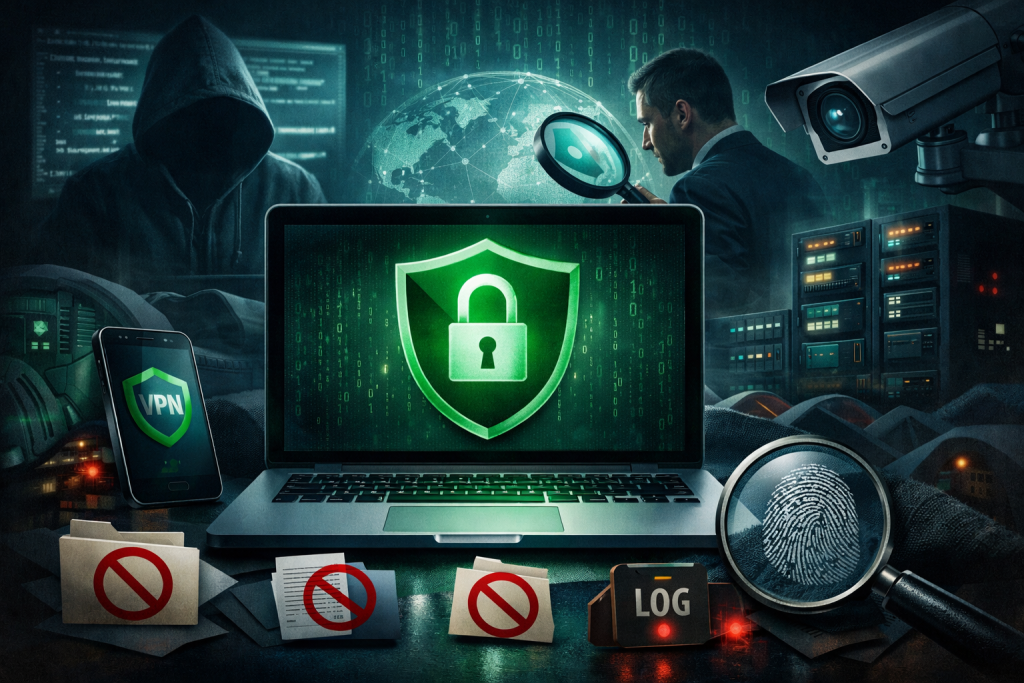
So, how do you separate the marketing fluff from the mathematically secure? For starters, you have to stop reading the homepage and start looking at the architecture. In 2026, trust is dead. Proof is everything.
Let’s dive deep into what data VPNs store, pull up some real-life court cases that prove (or bust) VPN no-log claims, and find out how to choose a true zero-log VPN provider that can actually keep your secrets.
“No-Logs” VPN vs. “Some-Logs” VPN
First, let’s clear up one thing: what is a no-log VPN? To the average user, this equals “We don’t store any data.” I hate to ruin it for you, but that’s just marketing. When a VPN says “no logs,” they usually mean “no activity logs.” This means they are not recording which websites you visit or what files you download. But in the world of forensics, “activity” is just the tip of the iceberg. To truly understand your risk, you need to understand the three layers of data collection.
Level 1: Activity logs
This is the data of what you did.
What it is:
- URLs visited (whistleblower.com)
- Files downloaded (evidence.zip)
- Search queries
The reality: Almost no paid VPN collects this. Storing this volume of data for millions of users is prohibitively expensive and legally toxic. If a VPN has this, they aren’t a privacy company; they are spyware.
Level 2: Connection logs
This is the data of who you are and when you were there. This is what brings down 99% of cybercriminals.
What it is:
- Timestamps: “User X connected at 10:01:05 AM and disconnected at 10:45:00 AM.”
- Bandwidth: “User X transferred 450 MB.”
- Original IP: “User X connected from Comcast IP 68.x.x.x.”
- Assigned IP: “User X was assigned VPN IP 185.x.x.x.”
The danger: You might think, “So what if they know I connected at 10 AM? They don’t know what I did.” But here’s the thing: intelligence agencies can use correlation attacks. If they know a hack occurred at 10:15 AM from VPN IP 185.x.x.x, they can subpoena the VPN for their connection logs. If the logs show you were the user assigned to that IP at that specific second, it’s game over. You don’t need to see the browsing history to prove guilt.
🧠 Also read: Is Big Brother Watching? The Truth About VPN Effectiveness Against Government Surveillance in 2026
Level 3: The “invisible” logs
This is the stuff most users forget.
- Device hashes: Some VPNs generate a unique ID based on your device’s hardware (screen resolution, OS version, battery ID) to “limit simultaneous connections.” This ID persists even if you change accounts.
- Payment links: If you pay with a credit card or PayPal, your “anonymous” VPN account is permanently linked to your real identity. A true no-log VPN must separate the payment profile from the usage profile.
A true zero-log VPN collects none of the above. If a server is seized, it should look like a factory-reset hard drive.
🧠 Also read: What a VPN Can and Can’t Protect You From in 2026
RAM-Only Servers: The New Standard
For years, the industry standard was to run VPN servers on hard drives. The problem? Hard drives remember. Even if you “delete” a log file, forensic experts can often recover it from the physical disk unless it has been overwritten multiple times.
And the VPN market adapted by introducing RAM-only servers (sometimes called “diskless” infrastructure). In this architecture, the VPN server has no hard drive. The entire operating system and software run on random-access memory (RAM).
🧠 Also read: 100 Gbps VPN Servers Are Here: Surfshark Sets New Industry Standard
What are RAM-only VPN servers good for? RAM is volatile memory. It requires electricity to hold data. The moment someone pulls the plug—whether it’s a scheduled reboot or a government raid—the data vanishes instantly. It is physically impossible to recover data from a powered-down RAM stick.
💡 Quick tip: How to Set Up a VPN at Home (Beginner-Friendly Guide)
RAM vs. encryption
However, not everyone agrees on this.
- The RAM camp: ExpressVPN (who pioneered this with their TrustedServer technology), NordVPN, and Surfshark have migrated their entire fleets to RAM-only infrastructure. Their argument is simple: you can’t hack what isn’t there.
- The encryption camp: Proton VPN deliberately does not use RAM-only servers. They argue that full-disk encryption (FDE) is sufficient because if a server is seized, the encryption keys are held off-site. They also claim that maintaining RAM-only infrastructure is complex and expensive to update.
Our opinion: While Proton is trustworthy (and their Secure Core architecture is brilliant), RAM-only is the superior failsafe. It removes the human error element of managing encryption keys. If the power goes out, the secrets are gone forever.
🧠 Also read: Best Free VPNs in 2025: Top Secure & Reliable No-Cost Options
VPN Jurisdiction: The “Eyes” and the Laws
Technology is only half the battle. The other half is the law. A VPN server is physically located in a country, and that country has laws that the VPN must follow.
The danger zones: Five Eyes, Nine Eyes, Fourteen Eyes
These are intelligence-sharing alliances. If a VPN is based in a Five Eyes country (USA, UK, Canada, Australia, NZ), the government can legally force them to start logging a specific user and then issue a gag order preventing them from telling you about it.
For instance, the U.S. has National Security Letters (NSLs). These are secret subpoenas that require no judge’s signature. A U.S.-based VPN could be compromised today, and they would be legally forbidden from updating their blog to warn you.
🧠 Also read: Why Wisconsin and Michigan Want to Ban Your VPN
The safe havens: Panama, BVI, Switzerland
This is why you see so many VPNs registered in exotic locations.
- Panama (NordVPN): Has no mandatory data retention laws. The government does not force companies to store user logs.
- British Virgin Islands (ExpressVPN, PureVPN): Operates under BVI law, which is distinct from the UK. To get data from a BVI company, the UK government has to go through a lengthy international legal request; they can’t just kick down the door.
- Switzerland (Proton VPN, PrivadoVPN): Famous for privacy. However, Swiss law does have provisions for assisting in criminal investigations, though they are much stricter than U.S. laws.
However, be aware that many “independent” VPNs are owned by large conglomerates. Kape Technologies (UK/Israel) owns ExpressVPN, Private Internet Access, and CyberGhost. Ziff Davis (USA) owns IPVanish and StrongVPN. While they operate as separate entities, corporate ownership can sometimes blur jurisdictional lines.
🧠 Also read: Digital ID and VPNs: How Privacy Fears Reshape Online Behavior
Safe Payment Options: The Final Link
You can use the most secure, RAM-only, BVI-based VPN with no logs in the world. But if you pay for it with your personal Chase Sapphire Reserve card, you have created a permanent link between your identity and that VPN account.
If privacy is your absolute #1 priority, you need to break the payment trail.
- The “Hi, I’m [your name]” option: Credit/debit cards and PayPal. They all require your ID, KYC, and are highly traceable.
- The “okay” option: Cryptocurrency. Adds a solid privacy layer, but note that Bitcoin is a public ledger and is traceable if your wallet is linked to your ID.
- The “best” option: Cash. Some VPNs accept cash sent in an envelope to their HQ. Some accept gift cards that you can purchase for cash. These methods, mixed with burner emails, leave zero paper trail.
The theory part is over. Now, to some real-life cases. Let’s see which VPNs have a no-log policy to show for it and which ones wish they’d never happened.
Zero-Log VPN Promises vs. Real Court Stories
Marketing claims are cheap. Court transcripts are expensive. The only way to know if a VPN no-logs policy holds water is to see what happens when a judge demands the bucket.
👍 ExpressVPN vs. Turkey (2017)
In a high-profile investigation into the assassination of the Russian ambassador to Turkey, authorities traced digital footprints to an ExpressVPN server. Turkish police raided the data center and physically seized the hardware.
The result: They found nothing. No logs, no user data, no connection history. The server was effectively a brick. So does ExpressVPN keep logs? No, and this case clearly proves that their no-logs policy isn’t just text on a website.
👍 Private Internet Access (PIA) vs. The FBI (2016 & 2018)
PIA’s case is unique because it is based in the USA (a Five Eyes country), which usually scares privacy purists. PIA has been subpoenaed by the FBI in multiple cases (2016 and 2018).
The result: In every instance, PIA testified in court that they could not provide data because it did not exist, proving, under oath, that their no-log VPN policy overrides their jurisdiction.
👎 EarthVPN vs. The bomb threat (2014)
A user connected to EarthVPN to send a bomb threat, relying on their “no logs” promise. He was arrested shortly after.
The result: While EarthVPN itself claimed not to keep logs, the third-party data center they rented the server from did keep IP transfer logs.
The lesson: A VPN is only as secure as its supply chain. This is why premium providers are moving toward “colocated servers”—hardware they own and manage themselves, rather than renting cheap space from generic hosts.
👎 IPVanish vs. DHS (2016)
This is the case that shattered trust in the industry. IPVanish (under previous ownership) claimed a strict zero-logs policy. Yet, when the Department of Homeland Security came knocking regarding a criminal investigation, the company handed over detailed logs.
The result: IPVanish provided the suspect’s real IP address, connection timestamps, and user details. It proved that a company can simply lie about its policy. IPVanish is now owned by Ziff Davis and has been audited, but the history serves as a warning.
👎 PureVPN vs. The cyberstalker (2017)
In 2017, the FBI was hunting a cyberstalker. They traced his activity to PureVPN. Despite having a privacy policy that shouted “zero logs,” PureVPN handed over netflow logs (timestamps and source IPs) that allowed the FBI to correlate the suspect’s home connection with the stalking activity.
The lesson: The connection logs PureVPN revealed were detailed enough to send a man to prison. PureVPN has since revamped its policy and architecture, but the scar remains.
🤔 The Swiss nuance: Proton Mail (2021)
In 2021, Proton Mail (the email service) was compelled by Swiss authorities to log the IP address of a climate activist. And they complied. Makes you think, does Proton VPN keep logs, too?
The important distinction: While Proton VPN’s no-logs policy hasn’t been put to a real-life test, under Swiss law, email services and VPNs are treated differently. Proton VPN cannot be compelled to log under the same statute (BÜPF) that applied to the mail service. However, it was a harsh reminder that legal pressure is real, and even the safest VPN jurisdiction can crack.
🧠 Also read: Types of VPN Explained: How Each Works and Which Is Best for You
The No-Log VPN Faceoff: Marketing vs. Reality
In 2026, you shouldn’t trust a VPN provider’s word. You should trust the Big Four auditing firms (PwC, Deloitte, EY, KPMG) or specialized security firms (like Cure53). A third-party audit means the VPN paid an external company to tear apart their code and servers to verify their claims.
Let’s take a look at some popular no-log VPN providers and how seriously they take their promise.
| VPN | RAM-only servers | Jurisdiction | Third-party audits (latest) | Safe payment options | |||||||||
|---|---|---|---|---|---|---|---|---|---|---|---|---|---|
| Proton VPN | No | Switzerland | Yes (Securitum, 2025) | CryptoCash |
| ||||||||
| NordVPN | Yes | Panama (owned by a Netherlands-based parent) | Yes (Deloitte, 2026) | CryptoCash |
| ||||||||
| ExpressVPN | Yes | British Virgin Islands (owned by a UK-based parent) | Yes (KPMG, 2025) | No |
| ||||||||
| Surfshark | Yes | The Netherlands | Yes (Deloitte, 2025) | Crypto |
| ||||||||
| CyberGhost | Yes | Romania (owned by a UK-based parent) | Yes (Deloitte, 2024) | Crypto |
| ||||||||
| VyprVPN | No | USA | Yes (Leviathan, 2018) | No |
| ||||||||
| Private Internet Access (PIA) | Yes | USA (owned by a UK-based parent) | Yes (Deloitte, 2024) | CryptoCash (via gift cards) |
| ||||||||
| Windscribe | Yes | Canada | Yes (Packetlabs, 2024) | Crypto |
| ||||||||
| TunnelBear | No | Canada (owned by a U.S.-based parent) | Yes (Cure53, 2024) | No |
| ||||||||
| Hotspot Shield | No | USA | Yes (AON, 2023) | No |
| ||||||||
| Norton VPN | No | USA | Yes (VerSprite, 2025) | No |
| ||||||||
| Mullvad VPN | Yes | Sweden | Yes (Assured, 2025) | CryptoCash |
| ||||||||
| PrivadoVPN | No | Switzerland | No | Crypto |
| ||||||||
| Hide.me | Yes | Malaysia | Yes (Securitum, 2024) | Crypto |
| ||||||||
| PureVPN | No | British Virgin Islands | Yes (Altius IT, 2024) | Crypto |
| ||||||||
| IPVanish | Yes | USA | Yes (Schellman Compliance, LLC, 2025) | No |
| ||||||||
| StrongVPN | No | USA | No | No |
|
So how do these 17 no-logs VPN services stack up?
🏆 The untouchables
These providers tick every single box. They run on RAM, operate in safer jurisdictions (or have proven they can withstand pressure), have the freshest audits, and let you pay with cash.
1. NordVPN
2. Mullvad VPN
3. Private Internet Access (PIA)
🥈 The strong contenders
These providers have excellent architecture (RAM-only + audits) but miss one minor feature (like cash payments) or sit in stricter jurisdictions.
4. Surfshark
5. Windscribe
6. Hide.me
7. CyberGhost
🥉 The mixed bags
Services that are trustworthy but rely on older tech (hard drives) or have glaring holes in their anonymity profile.
8. ExpressVPN
9. Proton VPN
10. PureVPN
11. IPVanish
🚩 The red flags
These providers failed critical checks: no RAM, old/no audits, or hostile jurisdictions with no anonymity tools.
- VyprVPN (⭐⭐): No RAM, USA-based, and the audit is ancient (2018). In 2026, that’s unacceptable.
- PrivadoVPN (⭐⭐): No audit. In this industry, “trust me, bro” is not a valid privacy policy.
- Norton/Hotspot Shield/TunnelBear (⭐⭐): All USA/Canada-based, no RAM servers, and no anonymous payment options. They may be fine for unblocking Netflix or YouTube, but do not use them for privacy.
- StrongVPN (⭐): No RAM, no audit, USA-based, no crypto. Avoid.
🧠 Also read: How to Choose the Best VPN for Your Device
Zero-Log VPNs: Trust Is Good, Proof Is Better
We started this article with a simple question: How do you figure out if the VPN “no logs” promise is real?
The answer, as we’ve discovered, is that you can never know for sure. And there’s certainly no easy way for how to check VPN logs yourself unless you are in the server room or reading the code.
But in 2026, blind trust is a vulnerability.
If you are part of the 23.5% of users from our survey who rely on a VPN for privacy, you cannot afford to settle for a polite “We promise” on a landing page. You need to look for proof behind it:
- The architecture: RAM-only servers that physically cannot retain data after a reboot.
- The law: A safe jurisdiction that legally permits the company to shred a subpoena rather than the user’s data.
- The money: A safe payment option (cash or crypto) that ensures your bank account never shakes hands with your VPN account.
Privacy is not a product you buy. It is a habit you build. It starts with the right software, it continues with how you pay for it, and it ends with what you do inside the tunnel. Choose your tools wisely, because in the end, the difference between a no-log VPN vs. a regular VPN is in its ability to say “No” when your data is at stake.
FAQs
What is a zero-log VPN?
A zero-log VPN (or no-log VPN) is a service that does not collect or store any data about your online activity. This includes your browsing history, DNS queries, and your original IP address. Ideally, it also means they do not store connection timestamps, which prevents correlation attacks.
How do I know if a VPN is truly no-log?
Since you cannot inspect their servers, you must look for three indicators:
- Independent audits: Recent reports from firms like Deloitte, PwC, or KPMG.
- RAM-only servers: Hardware that wipes all data upon reboot.
- Court cases: Real-world examples where the VPN was subpoenaed and had no data to provide.
Does NordVPN keep logs?
No. NordVPN has a strict no-logs policy that has been verified six times by independent auditors (most recently by Deloitte in early 2026). They operate on RAM-only servers (which wipe data on every reboot) and are based in Panama, a jurisdiction with no mandatory data retention laws. While they track basic payment data for refunds (unless you pay with crypto or cash), they do not store your browsing history, IP address, or connection timestamps.
Does Proton VPN keep logs?
No. Their no-logs policy has been audited by Securitum. However, unlike some competitors, they do not use RAM-only servers, relying instead on full-disk encryption. While secure, this architecture is theoretically more vulnerable to physical seizure if encryption keys are mishandled.
What does a VPN keep logs for?
Most free VPNs and low-tier paid VPNs keep logs (often connection logs or aggregated data) to sell to advertisers or limit your bandwidth. Only premium no-log VPN providers with verified architectures can be trusted to keep zero logs.
No-log VPN vs. regular VPN: What is the difference?
A “regular” VPN might hide your activity from your ISP, but the VPN company itself can still see and record everything you do (acting as a new ISP). A no-log VPN ensures that nobody—not even the VPN company—knows what you are doing.