Remember the promise that streaming would solve piracy forever? The logic was sound: give people an affordable, convenient library of everything, and they will gladly put away their torrent clients.
For a while, it worked. But we are in 2026 now, and the “Netflix and chill” era (in its original sense, of course) has morphed into “Subscribe to Netflix, Disney+, Hulu, HBO, Amazon, and Peacock, and then realize the movie you want is actually only available for rent on Apple TV.”
Subscription fatigue is real, and it has driven a massive migration back to the old ways. But the BitTorrent landscape you might remember from a decade ago has changed. The technology is sharper, the speeds are faster, but the eyes watching the swarm have multiplied.
If you are a returning pirate or a digital archivist refusing to let media vanish into the void of licensing disputes, you need to understand the new rules of engagement. Is torrenting safe like it used to be, and are VPNs the cure-all for staying off the radar? Let’s break it all down in this state of the union for P2P file sharing in 2026.
How Torrenting Works
Torrenting was never about stealing. It was about distribution. In an age where digital media can be retroactively edited or deleted from cloud libraries by the copyright holder, torrenting may be the last bastion of permanent ownership.
But what does “torrenting” mean? If you look up the “torrenting” definition, you’ll see that all search results come down to sharing and downloading files via a peer-to-peer (P2P) network. Unlike a direct download from a central server (like downloading a photo from Google Drive), there is no central warehouse. When you download a file, you aren’t getting it from a company. You are assembling it, piece by piece, from thousands of other users who already have it. But how does torrenting work exactly? That’s the interesting part.
The swarm
I bet many of you have heard terms like “seeds” and “leechers” without having a clue what they actually mean. Yet both are important to understand how the system works. These guys together are called a swarm—the collective group of all users (peers) sharing a specific file or set of files.
- Seeds: These are the heroes of the ecosystem. A seed is a user who has the complete file and is sharing it with others.
- Leechers: These are users currently downloading the file. As they grab pieces of data, they immediately start sharing those specific pieces with other peers.
- The tracker: A server that acts as a traffic controller, introducing leechers to seeds.
But how do they all communicate and ensure everyone gets their files intact in the end? Say hi to the BitTorrent protocol.
The BitTorrent protocol
Traditional downloading is like ordering a pizza. You call the restaurant (the server), and they send a driver to your house. If 10,000 people call the restaurant at once, the kitchen crashes, and nobody eats.
BitTorrent is a potluck. Nobody orders from a restaurant. Instead, everyone brings a slice of pizza. When you join the party, you aren’t just eating, but you are also expected to bring a slice for someone else.
The protocol breaks a massive file (the pizza) into thousands of tiny pieces. Your computer grabs piece #45 from a guy in Brazil, piece #802 from a server in Germany, and piece #1 from your neighbor.
So what is torrenting if we sum this up? It is a method of downloading and sharing files on a decentralized P2P network using the BitTorrent protocol. And this decentralized efficiency is the cornerstone of torrenting. You cannot kill a torrent by shutting down a server, because the file exists everywhere and nowhere at once.
However, this efficiency comes with a massive privacy trade-off. To receive data from a stranger, that stranger needs to know where to send it.
The Torrent Risks
This is the part that usually shocks newcomers. The P2P protocol is transparent by design. When you join a swarm, your IP address is not hidden; it is broadcast. It has to be, or else the data packets wouldn’t know how to find your device.
If you open the Peers tab in any torrent client right now, you can see a list of IP addresses from around the world. It means that if you can see them, they can see you. And “they” includes more than just fellow movie buffs.
Copyright trolls
All that secrecy and whispered conversations around torrenting make you wonder, is torrenting illegal? Let’s set it straight: the file-sharing technology itself is absolutely legal. What’s illegal is using it to download or share copyrighted material (movies, music, software, etc.) without the copyright holder’s permission. And the primary danger in 2026 isn’t the FBI kicking down your door for downloading a B-movie. It is the automated, relentless machinery of copyright enforcement.
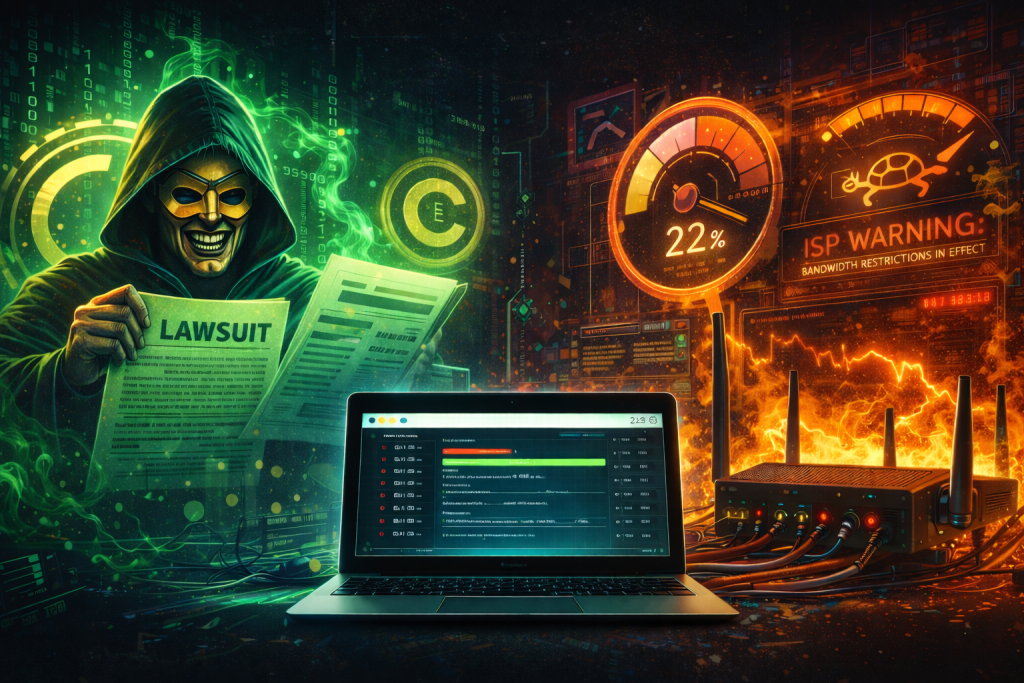
There is a common misconception that you are too small a fish to catch. That might be true for law enforcement, but not for copyright trolls. These are law firms that turn your torrent downloads into their revenue stream.
They don’t hack your computer. They simply join the swarm of a popular movie, log every IP address that connects to upload or download a piece of the file, and then subpoena the ISP to reveal the customer behind the IP.
Once they have your name, the letter arrives. It’s usually a settlement offer: pay $500–$1,000 now, or face a lawsuit for $150,000 in damages. It is a numbers game, and without protection, you are playing with the odds stacked against you.
ISP throttling
Even if you are downloading perfectly legal Linux ISOs or public domain content, your internet service provider (ISP) likely hates P2P traffic. It consumes massive bandwidth and strains their infrastructure.
But how to tell if an ISP is throttling P2P? If you have a gigabit connection but your torrents are crawling at 500 KB/s, the answer is likely yes. ISPs use deep packet inspection (DPI) to identify the P2P protocol signature. Once detected, they can automatically deprioritize your traffic. ISP throttling of P2P traffic usually doesn’t block you completely, but it makes the experience miserable enough that you give up.
The Role of VPNs
And now we get to the most important part: how do you avoid these risks? The answer is clear—a VPN.
🧠 Also read: VPN Usage Trends 2025: Which Countries Lead in VPN Adoption?
Torrenting without VPN protection is effectively walking into a police station and shouting your crimes. A VPN solves the two biggest problems of P2P: visibility and throttling.
Hiding the IP
When you connect to a VPN server—say, in Switzerland or Iceland—your real IP address is hidden and replaced by the server’s IP.
- In the swarm: The copyright trolls see the VPN’s IP address, not yours. Since premium VPNs operate on a strict no-logs policy, that IP leads to a dead end.
- Legal insulation: Your traffic is mixed with thousands of other users on the same server, making it impossible to single you out.
💡 Quick tip: VPN Privacy: Are You Really Anonymous?
Encrypting the traffic
A VPN wraps your traffic in military-grade encryption (usually AES-256). Your ISP can no longer see what you are doing. They can’t see that you are using the BitTorrent protocol. They only see a stream of encrypted nonsense. And they cannot throttle what they cannot identify.
So, do you need a VPN for torrenting in 2026? The answer is not just “yes”—it is “don’t even open the client without one.”
However, not all VPNs are created equal. Many free services explicitly block P2P traffic or, worse, collect and sell your data to cover their server costs.
The death of port forwarding?
If you’re a power user, you may have noticed fewer VPNs offering port forwarding. This feature used to be essential for maximizing upload speeds (seeding) by allowing incoming connections to bypass the NAT firewall.
However, in the past few years, major providers began axing this feature due to security vulnerabilities like the Port Fail attacks, which could de-anonymize users. While some providers still offer it, the industry is moving away from it. If you are just leeching (downloading), you don’t need it. If you are a serious seeder on private trackers, your options are shrinking.
🧠 Also read: VPN Blocking: Where, Why, and How VPNs Get Blocked—And What You Can Do About It
Critical Safety Features
Picture this: You buy the VPN. You turn it on, then start the download. You go to sleep. At 3:07 AM, your VPN connection hiccups for a split second. Your computer, desperate to maintain the connection, instantly reverts to your regular ISP internet. Boom. Your real IP is exposed to the swarm for ten seconds. That is all the copyright trolls need.
Most people rely on a kill switch to prevent this. A kill switch is designed to cut your internet if the VPN drops. It’s a good feature, but it is software, and software can fail or lag.
In 2026, smart torrenters don’t rely on kill switches alone. They use IP binding.
This is a setting inside your torrent client (like qBittorrent) that forces the application to only communicate through the VPN’s network interface. You basically tell the torrent client, “Listen only to the adapter named WireGuard Tunnel.” As a result, if the VPN drops, the network interface disappears. The torrent client doesn’t just “try” to switch to regular Wi-Fi; it physically cannot see the internet anymore. The download freezes instantly and totally.
It is fail-safe physics versus a software promise. Always choose physics.
🧠 Also read: How to Choose the Best VPN for Your Device
Best Practices for 2026
If you are ready to hoist the black flag, do it with style (and proper digital hygiene). The days of downloading Linkin_Park_Numb.exe and wondering why your computer crashed are over (hopefully), but the threats have evolved.
Sandbox your downloads
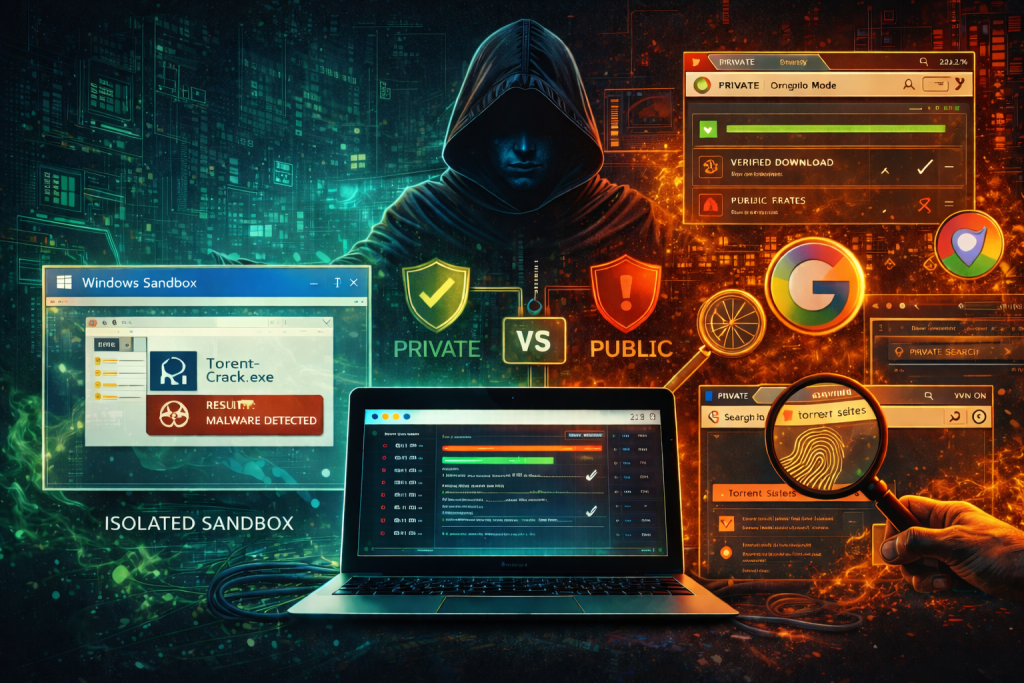
Torrent security risks often hide in plain sight. A video file is usually safe, but software cracks and keygens are prime vectors for malware. Before you install anything, scan it. Better yet, run it in a sandbox—an isolated environment that mimics your OS. If the file is a virus, it infects the sandbox, not your real machine. Windows has a built-in sandbox feature, and you should be using it.
Private vs. public trackers
Public sites (the ones you find via Google) are the Wild West. They are full of fake files, malware, and monitoring agencies. Private trackers are invite-only communities. They enforce strict rules:
- Ratio: You must seed (upload) as much as you download.
- Quality control: Mods verify files to ensure they aren’t malware.
- Privacy: Because the swarm is closed, copyright trolls rarely infiltrate them.
Getting in is hard, but once you are there, torrent download risks drop significantly.
Don’t ignore the metadata
Even with a VPN, your browser leaves fingerprints. If you are logged into Google while searching for torrent sites, you are creating a link between your identity and your activity. Use a privacy-focused browser or incognito mode when hunting for magnet links.
🧠 Also read: Digital ID and VPNs: How Privacy Fears Reshape Online Behavior
Summary table: The torrenting checklist
| Feature | Without a VPN | With a VPN | With a VPN + IP binding |
|---|---|---|---|
| IP visibility | Exposed to everyone in the swarm | Hidden (shows VPN server IP) | Hidden (zero leak risk) |
| ISP visibility | Full view of P2P protocol & files | Blind (encrypted data) | Blind (encrypted data) |
| Throttling risk | High | Low | Low |
| Fail-safe | None | Kill switch (can fail) | 100% traffic cut-off |
| Anonymity | None | High | Maximum |
The Final Verdict: Is Torrenting Safe in 2026?
The underlying technology hasn’t changed—how torrenting works is the same efficient, decentralized miracle it was twenty years ago. But the world around it has become significantly more hostile.
Is torrenting illegal? Not per se, but downloading or sharing copyrighted content without permission is. And as we have moved from an era of casual piracy to an era of automated surveillance, the swarm is no longer just a community of enthusiasts. It is a hunting ground for copyright trolls and a monitoring point for ISPs.
If you are going to participate in this ecosystem, do not be the low-hanging fruit. Use a reputable VPN, enable IP binding, and treat your digital footprint like the valuable asset it is. The internet never forgets, but with the right tools, it doesn’t have to know who you are.
FAQs
Is torrenting illegal?
Technically, no. The act of using the BitTorrent protocol is perfectly legal. You can torrent Linux distributions, public domain movies, and open-source software all day long. However, downloading copyrighted material (movies, games, music) without permission is copyright infringement, which is illegal in most jurisdictions. We do not condone piracy, but we vehemently support your right to privacy.
What is seeding in torrenting?
We already know who seeders are, but what does “seeding” mean in torrenting specifically? Seeding happens after you have finished downloading the file. You leave your torrent client open so that other users (leechers) can download pieces of the file from you. It’s the “give” in the “give and take” of P2P.
Usenet vs. torrenting: What’s the difference?
Usenet is often cited as a safer alternative. Unlike how torrenting works (connecting to other users), Usenet involves downloading files directly from centralized servers. It is generally faster and safer because you aren’t uploading to others, so you don’t appear in a swarm. However, Usenet usually costs money (monthly access fees) and is more complicated to set up. Torrenting remains free and more accessible.
How do I check my torrent IP?
If you want to be sure your IP isn’t exposed, run this simple torrent IP leak test:
- Connect to your VPN.
- Go to ipleak.net and click Activate under Torrent Address detection.
- Download the magnet link they provide into your torrent client.
- The website will track the IP address that the client is using to request that file. If the torrent IP address displayed on the site matches your real home IP, your VPN is leaking.
What are the risks of torrenting without a VPN?
Torrenting without VPN protection exposes you to three main threats:
- Legal trouble: Copyright holders can easily identify you.
- Throttling: Your ISP can slow down your internet speed.
- Cyberattacks: Malicious peers can use your exposed IP to scan for open ports on your router or launch DDoS attacks.
Can I get caught torrenting even with a VPN?
It is extremely rare but possible if:
- Your VPN disconnects, and you don’t have a kill switch or IP binding enabled.
- You use a free, shady VPN that logs your data and hands it over to authorities.
- You post your torrenting activity on social media linked to your real identity.
To minimize torrent risks, choose a reputable, paid VPN with an audited no-logs policy.