The internet is not a cloud; it is a physical network of cables, servers, and switches that costs billions to maintain. A VPN is essentially a private tunnel bored through this public infrastructure, shielding you from the prying eyes of advertisers, hackers, and surveillance states. But building a tunnel requires steel and concrete—or in our case, high-bandwidth servers, encryption overhead, and engineering talent.
So, when a company spends a fortune on this infrastructure but hands you the keys for $0, you have to ask yourself: Who is paying the bill? If they aren’t charging you a subscription, it doesn’t mean they are a charity. It means they are a business with a hidden revenue stream.
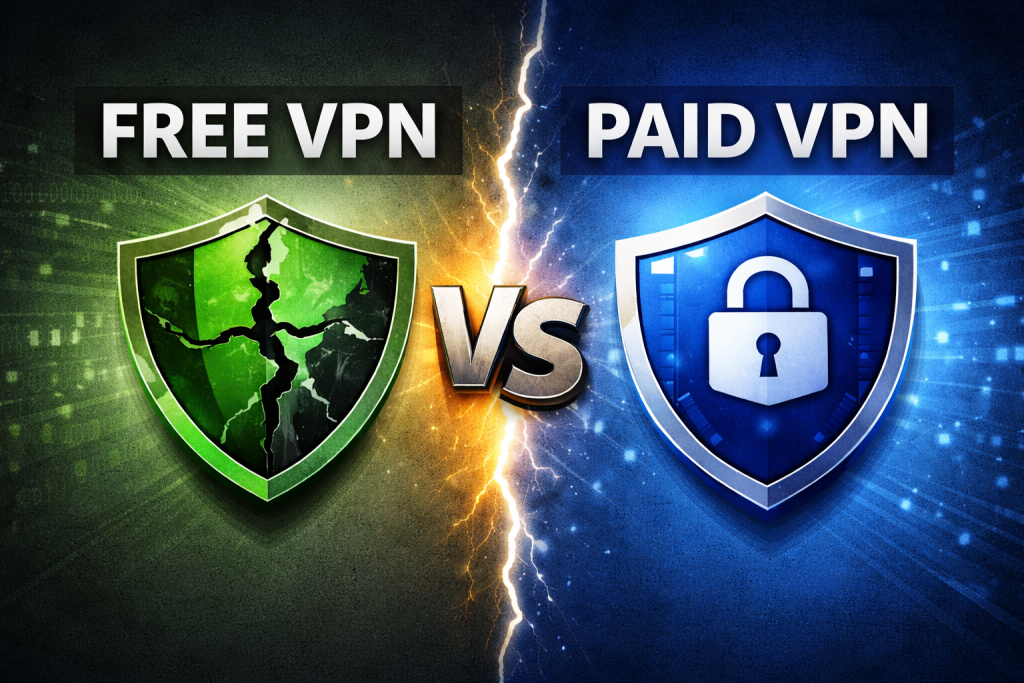
In 2026, the free VPN vs. paid VPN choice isn’t just about features, speed caps, or saving five dollars a month. It is the difference between being a valued customer and being unrestricted inventory.
So is it worth paying for a VPN, or can you still get by on the free tier without selling your soul? Let’s dissect the economy of privacy.
The Economics of “Free”: How Free VPN Services Pay the Bills
Bandwidth is expensive. Every gigabyte of data you route through a VPN server costs the provider money. If you aren’t paying that bill, someone else is. The risks of free VPN services usually boil down to how they balance this ledger.
The freemium model
This is the most honest approach. Companies like Proton VPN or Windscribe offer a free VPN version to act as a loss leader. They are willing to lose money on your free usage in the hopes that you’ll eventually get annoyed by the limitations and upgrade.
It’s a legitimate strategy, but it comes with manufactured friction. To nudge you toward their paid plans, they intentionally limit your experience. This might mean capping your data, throttling your speed, or restricting you to a handful of overcrowded servers—all to annoy you into pulling out your credit card.
The ad-supported model
Some free VPN services keep the lights on by blasting you with ads. In the best-case scenario, this is just a visual nuisance. In the worst-case scenario, the app is embedded with third-party trackers that build a profile of your usage to serve targeted ads—ironically defeating the purpose of a privacy tool.
The data harvesting model
Here is where the free VPN safety risks turn toxic. A significant portion of free VPNs exist solely to act as spyware. We saw this vividly with the Urban VPN scandal, where a popular “free” extension was caught injecting scripts into browsers to scrape AI chat logs. When a service offers unlimited everything for free, it is almost always because they are monetizing your data—selling your browsing habits, shopping data, and even connection logs to data brokers and hedge funds.
Why Free VPNs Can Be Dangerous
If selling your data is the business model, cutting corners is the operational strategy. And when a developer has zero budget for security infrastructure, the risks go far beyond just having your browsing history auctioned off to the highest bidder.
You become the server (the P2P trap)
This is one of the darkest secrets of the industry. To save on server costs, some sketchy providers turn their users into a peer-to-peer (P2P) network, where your traffic isn’t routed through a secure data center but through other users’ devices, and their traffic is routed through yours.
This means a stranger could be using your IP address to commit cybercrime, view illegal content, or launch botnet attacks. And when the police come knocking on the door, it’s your IP address on the warrant, not the VPN provider’s.
Malware and “malvertising”
Because these apps are often desperate for revenue, they don’t properly vet their ad partners and may allow malvertising—ads injected into your browser that carry drive-by downloads or malicious scripts.In worse cases, the VPN client itself is a Trojan horse, bundled with malware designed to scrape passwords or mine cryptocurrency in the background, turning your PC into a sluggish heater.
The “Swiss cheese” encryption
Building a robust encryption tunnel is hard; building a leaky one is easy. Many free VPN security risks stem from incompetence rather than malice. These services often leak your DNS requests (revealing which sites you visit to your ISP) or fail to mask your IPv6 address. You think you are anonymous, but to any network admin watching, you are wearing a camouflage jacket with neon flashing lights.
Missing features
One of the most critical free VPN limitations and risks is that they often lack basic security features—specifically, a kill switch. Without one, if the VPN connection drops for a split second (which happens often on overloaded free servers), your real IP is instantly exposed to the website you are visiting.
But is the entire free market a radioactive wasteland? Not quite. There are still honest services that refuse to play dirty.
The Good Guys: Legitimate Free Options
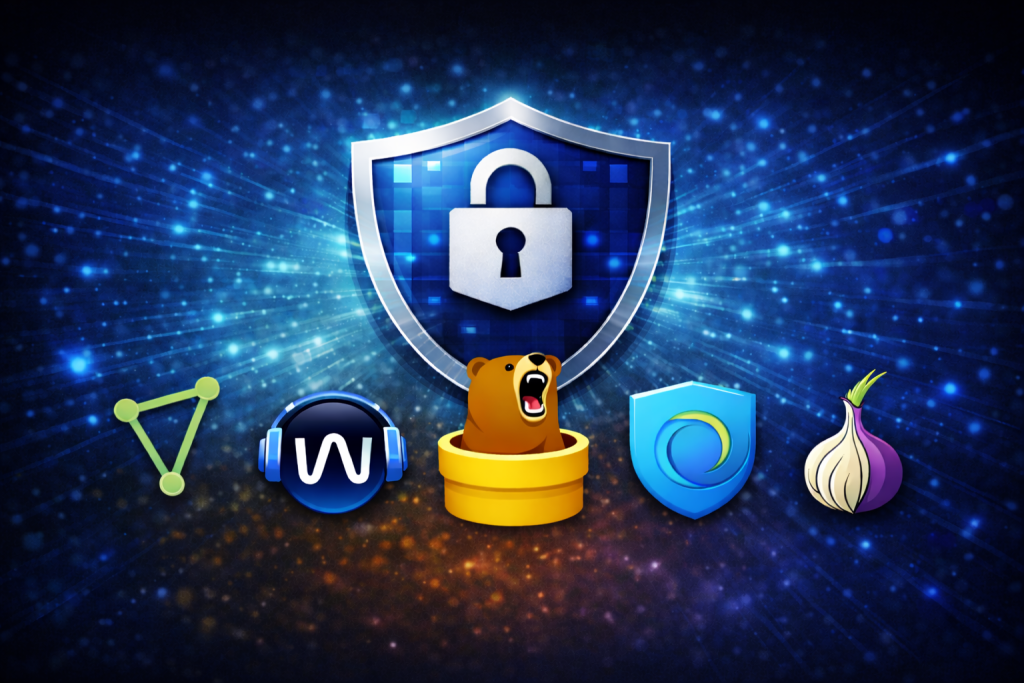
Despite the doom and gloom, not all freebies are traps. There is a small circle of trust—providers that use the freemium model to subsidize their free users with paid subscriptions.
Proton VPN
Proton is rare because it offers unlimited bandwidth on its free plan. You can leave it on 24/7 without worrying about hitting a wall. The service is backed by privacy-first Swiss jurisdiction and strong, externally audited data retention policies that exclude the common free VPN logging risks.
The trade-off: Servers. You can’t choose your specific server (it auto-connects you to the least crowded one), and it doesn’t support streaming.
Windscribe
Windscribe takes a different approach. They give you a generous 10 GB monthly cap and access to advanced features like their R.O.B.E.R.T. blocker.
The trade-off: Data cap. 10 GB vanishes quickly if you watch YouTube. It’s great for browsing but useless for binge-watching.
TunnelBear
TunnelBear is the only VPN that tries to win you over with charm rather than specs. It is incredibly user-friendly, with a playful interface full of animated bears that tunnel to different countries. On the free tier, you get access to servers in 47 countries and can connect unlimited devices.
The trade-off: Data cap. With only 2 GB per month, the free version is designed as a “test drive” for beginners. It’s perfect for checking your bank account while traveling, but if you try to stream a movie, you’ll run out of data before the opening credits roll.
Hotspot Shield
Hotspot Shield is famous for its proprietary Hydra protocol, which is genuinely fast. It’s a favorite for users who prioritize raw connection stability.
The trade-off: Speed and data caps. You are limited to 500 MB per day (which you can extend by watching ads), and your speed is artificially throttled to 2 Mbps. It’s great for reading news but terrible for anything that requires heavy lifting.
Tor VPN
Tor is a beast of its own. It’s volunteer-run and routes your traffic through a decentralized network of community nodes.The trade-off:Speed. Tor is agonizingly slow for media consumption. It is the ultimate tool for anonymity but a terrible tool for watching Stranger Things.
| VPN | The good | The catch |
|---|---|---|
| Proton VPN | ✔️Unlimited bandwidth ✔️Swiss privacy laws ✔️No ads | ✔️No server choice (auto-connect only) ✔️No streaming support |
| Windscribe | ✔️Generous 10 GB monthly cap ✔️Access to advanced features (R.O.B.E.R.T. blocker) ✔️10+ server locations | ✔️10 GB isn’t enough for serious streaming ✔️You have to provide an email to get the full allowance |
| TunnelBear | ✔️Extremely user-friendly ✔️Fun UI ✔️Access to servers in 47 countries | ✔️2 GB monthly cap |
| Hotspot Shield | ✔️Fast Hydra protocol ✔️Easy to use | ✔️500 MB daily cap ✔️Speed is throttled to 2 Mbps ✔️Ad-supported on mobile |
| Tor VPN | ✔️Total anonymity ✔️Decentralized network (no corporate owner) ✔️Impossible to trace | ✔️Painfully slow ✔️Not suitable for streaming or large downloads ✔️Some sites block Tor nodes entirely |
Of course, these aren’t the only trustworthy free VPN options. For a deeper dive into the specific pros and cons of other providers like PrivadoVPN and hide.me, check out our full breakdown of the best free VPNs in 2025.
The Premium Tier: What Do You Actually Pay For?
So, are paid VPNs worth it? If you value your time and your sanity, usually yes. When you pay for a subscription, you aren’t just paying for an app; you are funding an arms race against censorship and geoblocking.
The streaming cat-and-mouse game
Can a VPN help bypass georestrictions in 2026? Yes, but it’s harder than ever. Streaming giants like Netflix and Disney+ block recognized VPN IP addresses aggressively.
Paid providers employ teams of engineers whose sole job is to rotate IPs and outsmart these blocks. This is why the best VPN to bypass a geoblock is almost always a paid one. Free VPN services rarely have the resources to play this game, and if a server gets banned, it stays banned.
Obfuscation & censorship resistance
Standard protocols won’t cut it for a VPN block bypass in most cases. Whether you’re using a VPN to bypass the Great Firewall of China or to evade DPI (deep packet inspection) in a corporate office, you’ll need a VPN obfuscation feature (usually called “Stealth Mode”), which you’re unlikely to find in a free service. This scrambles your VPN traffic to make it look like regular HTTPS web browsing, allowing you to slip past firewalls that actively hunt for VPN signatures.
💡 Quick tip: Types of VPN Explained: How Each Works and Which Is Best for You
Advanced security features
Premium fees fund premium hardware. Here are some features often specific to paid tiers:
- RAM-only servers: Most top-tier providers run on RAM-only diskless servers. If the server is seized or rebooted, all data is instantly wiped.
- Multihop: Routing your traffic through two servers instead of one for double encryption.
- Threat protection: Blocking malware and trackers at the DNS level.
🧠 Also read: How to Set Up a VPN at Home (Beginner-Friendly Guide)
Why 2026 Changes the Calculus
A few years ago, the risks of free VPN apps were mostly about them seeing which websites you visited. In 2026, when VPN tools are becoming indispensable, the stakes are higher.
With the rise of AI integration, we are pasting more sensitive data into our browsers than ever before. As the Urban VPN incident proved, malicious extensions can scrape the DOM (the structure of the webpage) to capture your interactions with tools like ChatGPT or Gemini.
Furthermore, as digital ID laws tighten globally, maintaining anonymity is becoming a technical challenge. The EU, Australia, and the UK are creating blueprints that other nations are eyeing. To evade these dragnets, you need stealth VPN capabilities that free tools simply don’t provide.
🧠 Also read: Digital ID and VPNs: How Privacy Fears Reshape Online Behavior
Additionally, home internet speeds have skyrocketed. If you have a gigabit fiber connection, routing it through a congested free VPN server is like buying a Ferrari and driving it exclusively in school zones.
Free VPN vs. Paid VPN: Which Should I Choose?
The verdict depends entirely on your threat model. If you need to bypass a geoblock once a month to read a news article or protect yourself on public Wi-Fi for 20 minutes, a reputable free VPN like Proton or Windscribe is a solid tool. It is safe, honest, and cost-effective.
However, if you need a VPN for your daily life—for high-speed streaming, for bypassing censored websites, or for ensuring your medical and legal AI chatbot queries remain private—pick a paid tool with a stealth VPN protocol. In that case, the “free” option can become the most expensive one in terms of time and privacy lost.
So is paying for a VPN worth it? In 2026, privacy is a right, but servers are a service, and the risks of free VPN apps are more real than ever. In the end, it comes down to deciding if you want to pay with your wallet or your identity.
FAQs
What are the risks of using a free VPN service?
The primary risks of free VPN apps include data logging (selling your browsing history), malware injection (especially in browser extensions), bandwidth theft (some services use your PC as an exit node for others), and weak encryption standards (some sketchy providers still use obsolete protocols like PPTP, which can be cracked easily by modern computers).
Can free VPNs unblock Netflix in 2026?
Generally, no. Streaming services blocklist known VPN IP addresses. The best VPN to bypass a geoblock is usually a paid one that constantly refreshes its IP pool to stay ahead of the bans.
How to bypass censorship with a VPN?
For a VPN to bypass a website that is blocked by censors, the app should feature obfuscation. This disguises VPN traffic as normal web traffic. A free VPN with obfuscation is a rarity, meaning the firewall will likely detect and block the connection immediately.
Is it safe to use a free VPN for online banking?
It is risky. While the encryption might be sound on a legitimate free VPN, the lack of premium features could result in connection drops, exposing your real IP. Worse, a malicious free VPN could capture your session data. For banking, stick to premium providers or no VPN at all (using standard HTTPS).