The EU digital ID plan is in full swing—Europe is building an interoperable wallet network so your verified attributes (age, nationality, etc.) work across borders. And this is not some distant future but today’s reality: member states must make at least one EU Digital Identity Wallet (EUDI) available to residents by the end of 2026.
So let’s try to figure out how digital ID age verification works in the EU, what will change for users, what to watch for, and what you can do right now to maintain your privacy.
Where EU Age Verification Stands
2024 was the turning point for age verification in the EU: the EU Digital Identity Regulation, also known as eIDAS 2.0 (the updated framework that amends the original eIDAS Regulation), came into force, introducing the EUDI Wallet and setting a deadline for member states to provide their own wallet designs by the end of 2026. To bridge the gap, the European Commission released the age verification blueprint in 2025 so platforms can start using age verification methods before each country rolls out its wallet.
Meanwhile, the Commission’s guidelines under the EU Digital Services Act (DSA), published in July 2025, make protecting minors a legal duty. And while the guidance explicitly recommends attribute-only attestations over ad hoc ID dumps, no doubt there will be a messy transition period with mixed verification methods coexisting. However, the trend is clear: more mandatory age assurance across the EU.
EU Digital Identity Wallet—How It Works
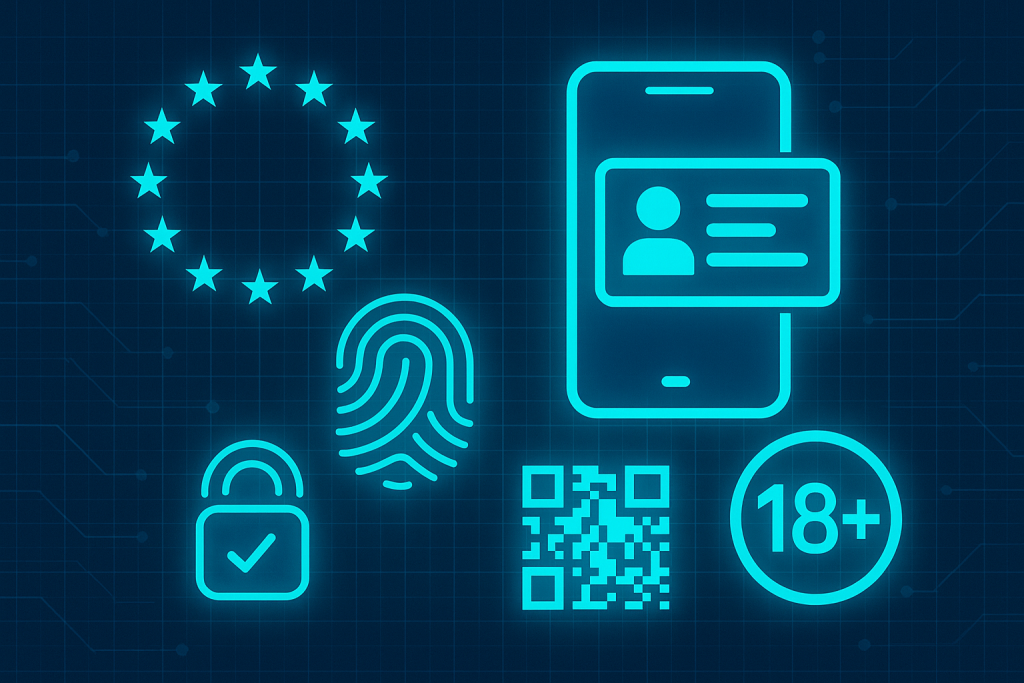
Europe’s Digital Identity Wallet is basically an app on your phone that lets you prove who you are online. The cornerstone of the system is selective disclosure—a privacy-preserving verification method that allows you to select which data to share instead of giving the whole passport every time. For instance, if a service needs to confirm your age or nationality, the Wallet will let you prove that you’re over 18 or hold a certain state’s passport.
The Wallet works across all EU member states. If one country issues an attestation, another country can accept it. This makes the EU Digital ID useful for tasks like signing forms, proving your age, and accessing services anywhere in the EU..
Sounds sweet, but is the digital ID safe? That is one good question. Implementation will differ across the EU. Each member state will set its own rules for how the Wallet works. Issuers and verifiers will need to form trusted networks. Platforms will decide which attestations they accept. In the end, the privacy and security of Europe’s attribute-only digital identity system will depend on how well each participant builds it.
EU Online Age Verification: Methods, Trade-Offs, and Privacy Costs
The EU’s age verification playbook doesn’t push for a single method and instead splits them into three groups: self-declaration, age estimation, and age verification. And it seems that the age of light checks is gone: regulators want proof and require age assurance to be “accurate, robust, reliable, non-intrusive, and non-discriminatory.” The following methods are listed as appropriate:
- EU Digital Identity Wallet. The Wallet is intended to become a unified, EU-wide solution that will verify your age with a simple token you show from an app. This method shares minimum data and is device-based—best for privacy in theory, but the actual result will largely depend on national wallet design in each member state.
- National ID. The guidelines list methods relying on verified and trusted government-issued IDs as effective ones, as long as they are based on anonymized tokens and use cryptographic protections like key rotation or zero-knowledge proofs. It’s very reliable and hard to spoof if implemented right.
- Audited third-party attestations. These usually include age assurance by confirming age using financial, telco, or KYC sources. The guidelines allow for such checks if they prove to be accurate and comply with other requirements. Those are convenient, but the verification provider gets access to your financial records, which are often targeted by bad actors—so it comes down to how securely they store your data.
- Age estimation. AI-based face-matching systems and other age estimation methods that infer your likely age (for example, from behavior signals) can be used if proven comparably accurate and independently audited. Those are probably the simplest to implement but are often intrusive and may store biometric data—not the best option for privacy.
What else do the regulators want from platforms? They must offer choice (more than one method), provide redress, and avoid storing anything beyond the user’s age group. Self-declaration is ruled out as insufficient. Cryptographic, device-based approaches are recommended, with (who would have thought) the EU Digital Identity Wallet as the golden, privacy-first standard.
How the EU’s Plan Differs from Others
When you’re weighing the EU digital ID pros and cons against other countries, its strength is interoperability and an attribute-first design at a pan-European scale. By comparison, the UK digital ID plans are more national-first (primarily right-to-work checks), while Australia’s rollout initially targets government services. Plus, the EU digital ID pilot is notable for its cross-border scope—tokens are designed to travel between member states, which raises both opportunity and complexity.
💡 Quick tip: Age Verification & Digital ID: A 2025 Privacy Reality Check
Real Risks Users May Face
It’s clear that EU digital identity regulations and stronger age verification are meant to protect kids, but any system that ties your real identity to online gates is bound to have weak points. Here are the real risks users should watch for:
- Data leaks from verifiers and platforms. Even “attribute-only” checks can be undermined if verifiers or platforms log requests, timestamps, or attestations, opening the door for profiling.
- Single-point centralization. When data gathers in one place, it’s a low-hanging fruit for hackers. And a single breach in the issuer database or a processing hub could result in massive data exposure.
- Exclusion. Migrants, refugees, the elderly, and people without smartphones may become locked out. “Interoperable” doesn’t automatically mean “inclusive.”
- Scope creep. What starts as a harmless “18+” verification can be repurposed for marketing, credit, or employment checks, turning a tool that’s been purposed for privacy into an endless digital checkpoint.
- Profiling and commercial reuse. Commercial attestations may share your behavioral signals, which are valuable for ad targeting. Insufficient control over data storage and retention can undercut the EU’s age verification goal of minimal disclosure.
- False positives. With age estimation checks, there’s always a risk they can wrongly deny access to legitimate users—a real problem when the result is account suspension.
- Biometric risks. Face matching and liveness checks are convenient but risky: unlike passwords, leaked biometrics can’t be changed.
All of these risks are real, and whether they will materialize depends on how seriously the EU and each member state will take their privacy-first promise.
Will a VPN Help?
VPNs are getting more popular around the world, and Europe is no different in this trend. However, despite being useful, they won’t solve the core problem. A VPN hides your IP, allowing you to appear to be surfing from another country and bypass geoblocks, and is a good layer of network privacy.
It’s handy when you don’t want ISPs or ad networks to map your session, but EU digital ID checks are meant to be server-side, not IP-based. So unless a service relies solely on geolocation-based checks, a VPN won’t stop a site from asking for your ID, nor will it erase attestations the platform has already recorded.
💡 Quick tip: Types of VPN Explained: How Each Works and Which Is Best for You
That said, treat a VPN as part of your toolkit for location and traffic obfuscation, along with tools like Tor, and don’t rely on it to be an identity shield.
What EU Users Should Do Now
The EU Digital Identity Wallet is imminent, and we’ll soon have to embrace this new digital ID reality. And while on paper it sounds sweet—privacy-preserving, attribute-only—the rollout will likely be messy. But this doesn’t mean we can’t do anything. Here are some tips to keep your privacy tight:
- Pick attribute-only options first. Whenever a site offers an EU Wallet or device-based token, use it instead of uploading a full ID. It leaks far less.
- Read the privacy notice. Check what the platform logs about attestations and how long it keeps them. Skip services with vague retention policies.
- Avoid uploading the whole ID unless there’s no other option. Don’t give scans/photos of passports to services unless they legally require it and have adequate retention and deletion policies.
- Minimize payment linkages. Where possible, use payment methods that do not reveal full financial histories.
- Keep options open. Use platforms that let you choose between methods so you’re not excluded if one route fails.
- Use separate accounts. Don’t put all your eggs in one basket—keep dedicated accounts and emails for different services.
- Use a reputable VPN for network privacy. But don’t count on it to beat server-side ID checks. VPNs help hide your IP from the ISP and services but are useless against platform-based verifications.
💡 Quick tip: How to Set Up a VPN at Home (Beginner-Friendly Guide)
FAQs
What is the EU digital ID?
The EU Digital Identity Wallet (EUDI) is a certified, cross-border digital ID wallet that lets EU residents hold and share verified attributes, like age and nationality, with public and private services.
How does EU online age verification work?
Under the EU Digital Services Act and guidelines from the European Commission, platforms can accept EU Digital Identity Wallet attestation and national IDs as effective age assurance methods, as well as audited third-party checks and age estimation systems, as long as they’re accurate, reliable, non-intrusive, and non-discriminatory.
Will the EU digital ID be mandatory to use for websites or services?
No—the EU Digital Identity Wallet will be an available attestation method—at least at first. Whether you must present one will depend on the platform’s policies and applicable national or EU rules.
Are VPNs legal in the EU and can they bypass online age verification?
VPNs are legal in the EU and are useful for IP-level privacy, but they don’t bypass wallet-based attestations or server-side identity checks.